
Reactive Maintenance
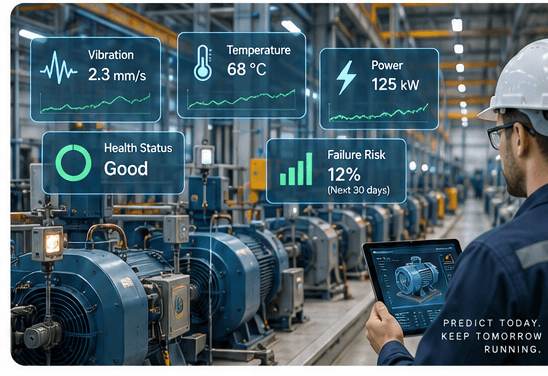
Equipment problems are often discovered only after performance deteriorates or a component fails, resulting in unplanned downtime and production disruption.
Case StudyIndustrial IoT & Predictive Maintenance
01Executive Summary
From reactive maintenance to real-time asset intelligence.
Industrial environments generate continuous streams of equipment and operational data, yet maintenance decisions are often still based on fixed service schedules or reactive responses after a problem occurs.
An Industrial IoT solution was designed to transform equipment telemetry into real-time asset intelligence. It combines edge connectivity, cloud processing and AI/ML with an Industrial Digital Twin, enabling continuous equipment-health monitoring, anomaly detection, degradation analysis and predictive maintenance before failures disrupt production.
Instead of relying solely on predefined thresholds, the Industrial IoT platform brings together real-time and historical machine data, while AI/ML models analyze combinations of signals and operating patterns. The Industrial Digital Twin turns these insights into a live operational view, helping maintenance teams move from reactive and schedule-based servicing toward condition-based and predictive maintenance.
02The Challenge
Equipment problems are often discovered only after performance deteriorates or a component fails, resulting in unplanned downtime and production disruption.
Vibration, temperature, pressure, power consumption, runtime, PLC and other operational data are distributed across machines and systems, making holistic analysis difficult.
Preventive maintenance based on fixed intervals can result in unnecessary servicing while still failing to prevent unexpected breakdowns.
Traditional threshold-based monitoring detects known conditions but struggles to identify complex degradation patterns developing across multiple signals over time.
03The Solution
An Industrial IoT platform was designed to continuously connect physical industrial assets with an Industrial Digital Twin and predictive maintenance capabilities.
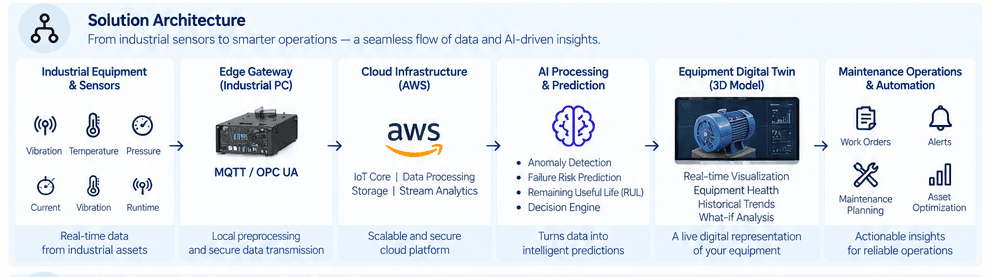
Industrial IoT sensors, PLCs, SCADA and existing industrial systems collect operational telemetry such as vibration, temperature, pressure, energy consumption and equipment runtime. Edge gateways preprocess and securely transmit Industrial IoT data to the cloud, where it is combined with historical equipment behavior and maintenance information.
AI/ML models analyze this Industrial IoT data for anomalies, degradation patterns and emerging risks. The Industrial Digital Twin provides engineers with a live representation of equipment health, while the AI-driven decision layer converts predictions into actionable maintenance recommendations.
04Solution Architecture
A seamless flow of data and AI-driven insights across industrial equipment, edge connectivity, cloud processing, prediction, the Digital Twin and maintenance operations.
05Core Architectural Pillars
Industrial IoT sensors, PLCs, SCADA and equipment telemetry are integrated through edge gateways for continuous, secure collection of operational signals.
Machine-learning models analyze real-time and historical telemetry to identify abnormal behavior, degradation trends and emerging failure risks.
A live Industrial Digital Twin consolidates machine condition, Industrial IoT telemetry, detected anomalies, maintenance status and predicted risks.
The platform can recommend inspection, component replacement, load adjustment or scheduled maintenance based on equipment condition and predicted risk.
Alerts and recommendations can integrate with CMMS, EAM or ERP environments to notify engineers and create maintenance work orders.
06Key Features & Platform Capabilities
Industrial telemetry is connected across machine, production-line and fleet level to support monitoring, prediction, visualization and maintenance operations.
07Representative Operational Scenarios
Changes in vibration, temperature and power consumption can indicate progressive bearing degradation. AI/ML identifies the combined pattern and supports intervention during a planned maintenance window.
The platform detects deviations from normal operating behavior and identifies emerging performance degradation before it develops into an equipment failure.
Equipment health and predicted maintenance needs can be considered alongside production schedules, helping teams select intervention windows with minimal manufacturing impact.
Increasing power consumption without corresponding output can indicate equipment degradation and trigger investigation before the condition becomes critical.
08Business Impact & Expected Results
Emerging equipment problems can be identified before they develop into production-stopping failures.
Condition-based maintenance reduces unnecessary servicing while helping prevent expensive emergency repairs.
Early detection of abnormal operation helps prevent continued operation under damaging conditions and secondary component damage.
Predicted risks allow maintenance teams to coordinate interventions with production schedules, spare-parts availability and engineering resources.
Equipment telemetry, health indicators, maintenance history and predicted risks are consolidated into a single operational view.
The architecture can expand from an individual machine to production lines, factories and distributed equipment fleets.