
Fragmented IoT Data
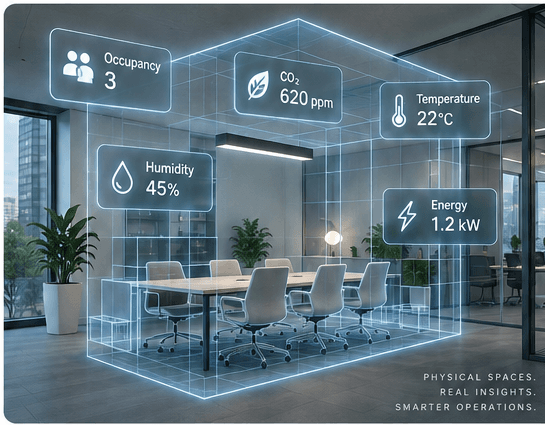
Occupancy, environmental conditions, and energy consumption are captured by separate devices and systems.
Case StudySmart Buildings & Facility Management
Connecting physical spaces with real-time data to create smarter, safer and more efficient buildings.
01Executive Summary
Managing modern facilities requires more than dashboards and isolated IoT sensors.
Facility operators need a real-time understanding of how spaces are being used, what environmental conditions exist, and how building systems should respond.
A cloud-based Digital Twin platform was engineered to create a live 3D representation of a physical facility, combining IoT telemetry, occupancy data, environmental sensors, and energy consumption into a single operational interface.
The solution enables facility managers to monitor spaces in real time and uses an AI-driven decision layer to interpret changing conditions, select appropriate operational responses, and orchestrate lighting, ventilation, and other connected equipment.
02The Challenge
Occupancy, environmental conditions, and energy consumption are captured by separate devices and systems.
Lighting, ventilation, and other equipment often operate according to fixed schedules rather than actual room usage.
Facility managers lack a unified real-time view connecting physical spaces, occupants, environmental conditions, and energy consumption.
03The Solution
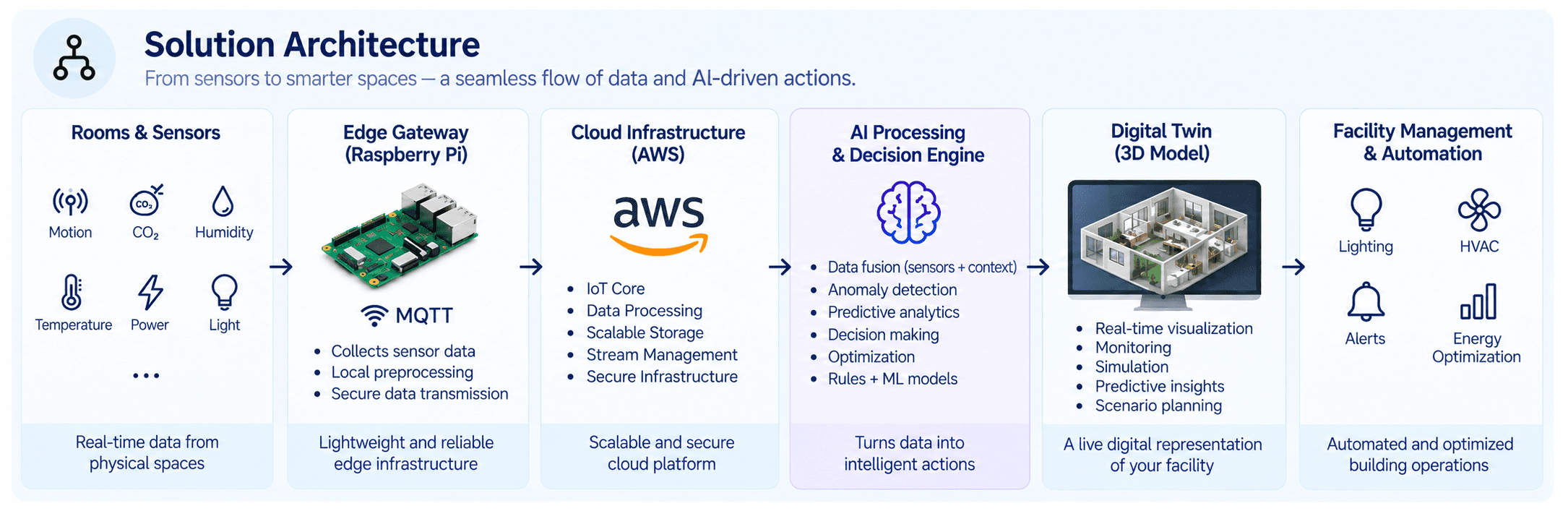
IoT sensors communicate through Raspberry Pi edge gateways using MQTT, continuously streaming occupancy, CO₂, temperature, humidity, motion, and energy-consumption data to the cloud.
The Digital Twin processes these signals in real time, visualizes the state of rooms and connected equipment, and combines deterministic rules with AI-assisted decision making.
Instead of relying only on fixed protocols, the AI layer can evaluate multiple signals and occupancy patterns together to determine or recommend the most appropriate facility-management action.
04Solution Architecture
A seamless flow of data and AI-driven actions, from the physical environment through cloud processing and the live Digital Twin to optimized building operations.
05Core Architectural Pillars
A browser-based 3D model represents buildings, floors, rooms, connected devices, and their current operational state, providing facility managers with a single visual command center.
Raspberry Pi gateways and MQTT provide a lightweight integration layer for heterogeneous sensors and actuators, including motion, occupancy, CO₂, humidity, temperature, and power-consumption devices.
An intelligent decision layer evaluates telemetry, occupancy patterns, and operational context to determine appropriate actions. It complements deterministic rules by dynamically selecting or recommending responses such as lighting, ventilation, HVAC adjustments, alerts, and energy-saving modes as conditions change.
06Key Features & Platform Capabilities
The platform turns connected data into a clear view of present conditions, practical automation and a foundation for continuous optimization.
Live facility model with room- and device-level status.
Real-time visibility into space utilization and traffic.
CO₂, temperature and humidity in one operational view.
Continuous monitoring of power usage across connected areas.
Occupancy-based control of connected equipment.
Dynamic operational responses based on telemetry, occupancy and context.
Usage and energy data for optimization.
Cameras, sensors and building equipment.
07Business Impact & Results
Building equipment operates according to actual occupancy rather than static schedules.
IoT telemetry, occupancy, environmental conditions and energy usage are consolidated into a single operational view.
Sensor data and occupancy context are converted into dynamic operational decisions, reducing dependence on manual monitoring and rigid fixed-rule automation.
The architecture can expand from individual rooms to entire buildings and support offices, hotels, event venues, airports and other complex facilities.