
Complex Multi-Vendor Ecosystem
Supporting sellers with independent catalogs, pricing models, commissions, inventory, payouts and fulfillment workflows creates significant platform complexity.
Case StudyRetail & Multi-Vendor Marketplaces
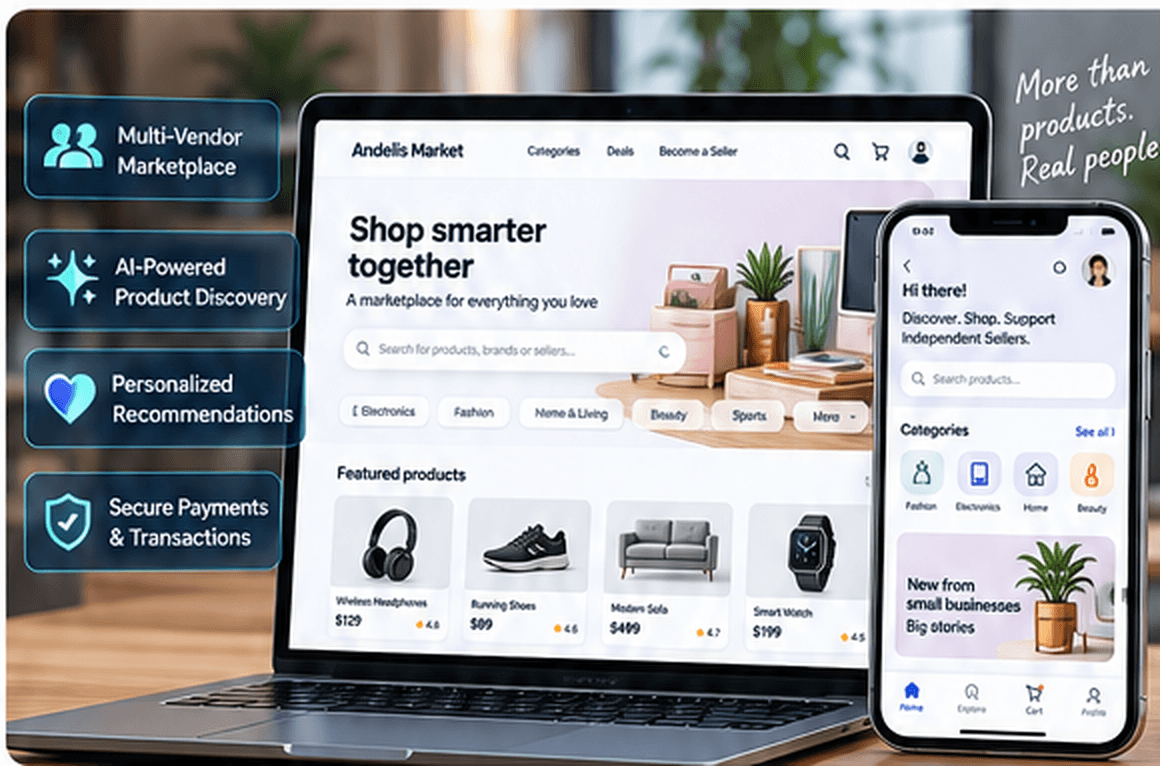
A modern, AI-powered marketplace solution connecting buyers and sellers through intelligent product discovery, secure transactions and efficient order fulfillment.
01Executive Summary
A composable marketplace connecting buyers, sellers and intelligent commerce.
We designed a scalable multi-vendor marketplace platform that enables businesses to connect buyers and sellers through a modern, cloud-native commerce experience. The solution supports product discovery, seller operations, catalog management, checkout, payments, inventory and order fulfillment across web and mobile channels.
AI is embedded where it creates practical retail value: semantic product search, recommendation and ranking, customer and product insights, fraud and anomaly detection, and demand forecasting. The platform combines composable commerce architecture with AI-driven intelligence while keeping core transactional flows secure, reliable and independently scalable.
02The Challenge
Supporting sellers with independent catalogs, pricing models, commissions, inventory, payouts and fulfillment workflows creates significant platform complexity.
Large and constantly changing catalogs make relevant search, ranking and recommendations critical to conversion and customer experience.
Seasonal promotions, campaigns and product launches can produce sharp traffic spikes across search, cart, checkout and payment services.
Marketplace platforms must coordinate payment providers, shipping and logistics, CRM, ERP/PIM, identity, tax and communication services.
03The Solution
A cloud-native, composable marketplace platform was designed around independently scalable services for catalog, sellers, orders, payments, inventory, reviews, notifications and fulfillment. API-first integration allows the platform to evolve without tightly coupling customer-facing channels to the commerce core.
Modular commerce services allow catalog, seller management, checkout, orders, inventory and payments to scale and evolve independently.
AI/ML improves product search, semantic matching, ranking, recommendations and personalized merchandising based on customer and catalog context.
Stateless APIs, asynchronous processing, caching and cloud-native infrastructure support traffic peaks and high transaction volumes.
Seller onboarding, catalog administration, commission models, order lifecycle management and payouts are handled through dedicated workflows.
Payment gateways, shipping providers, ERP/CRM/PIM, identity platforms and notification services are integrated through stable APIs and event-driven flows.
04Solution Architecture
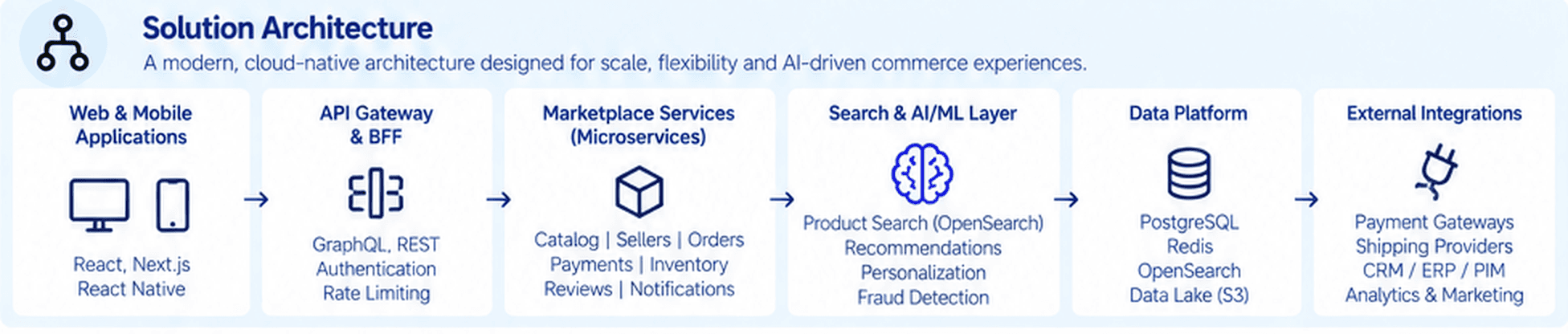
Web & Mobile Applications → API Gateway / BFF → Marketplace Services → Search & AI/ML Layer → Data Platform → External Integrations
05Core Architectural Pillars
React, Next.js and TypeScript provide fast web experiences, while React Native can support mobile commerce applications.
GraphQL and REST endpoints centralize authentication, rate limiting and experience-specific APIs.
Catalog, sellers, orders, inventory, cart, checkout, payments, reviews and notifications are separated into independently deployable services.
OpenSearch supports catalog discovery while AI/ML services power semantic search, recommendations, personalization, fraud detection, demand forecasting and customer insights.
PostgreSQL supports transactional workloads, Redis handles low-latency caching and sessions, and S3/data-lake services support analytics and machine-learning workloads.
Kafka and AWS messaging services decouple order, payment, inventory, notification and analytics workflows.
06Key Features & Platform Capabilities
07Technology Stack
08Business Impact & Expected Results
Composable architecture allows teams to launch new features, seller models and customer experiences without rebuilding the commerce core.
AI-powered search, ranking and recommendations help customers reach relevant products faster.
Seller onboarding, flexible commissions and scalable catalog management support broader assortment and new marketplace models.
Cloud-native services can scale independently around seasonal traffic, promotions and growing transaction volume.
Automation across orders, inventory, seller workflows and analytics reduces manual marketplace operations.
API-first architecture makes it easier to introduce new channels, integrations and AI capabilities over time.